Five Reports to Look at Every Week
You don’t need to become a numbers person. You need ten minutes, once a week, with the same five screens — until reading them is as automatic as unlocking the shutter. Here’s the owner’s weekly round, and what each report is quietly telling you.
1. Daily sales — the pulse
Start with the simplest question: what did we sell? The daily sales report gives each day’s total, discounts, and per-shop breakdown — a week of these side by side is your shop’s heartbeat.
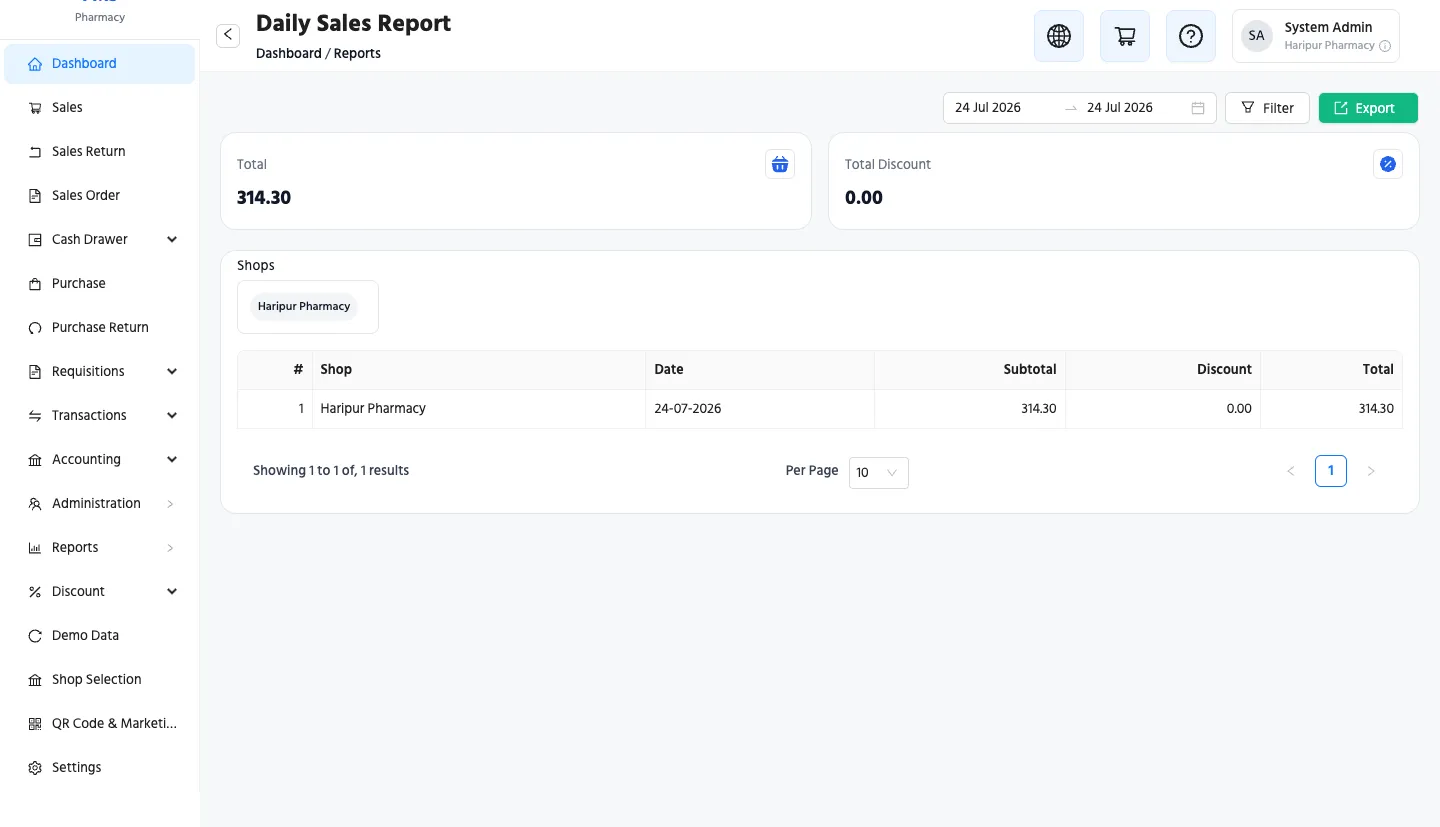 One day, one number, no arithmetic. Weekday patterns emerge within a
month — and a flat Tuesday stops being a mystery and starts being a
question.
One day, one number, no arithmetic. Weekday patterns emerge within a
month — and a flat Tuesday stops being a mystery and starts being a
question.
What to look for: not the number itself, but the shape. Which weekday is consistently weak? Did the dip start when the new pharmacy opened down the road, or when your best salesperson changed shifts?
2. Sales by invoice — the texture
Totals hide as much as they tell. The invoice-level report shows each sale: how many items, what discount, how much cash, how much due.
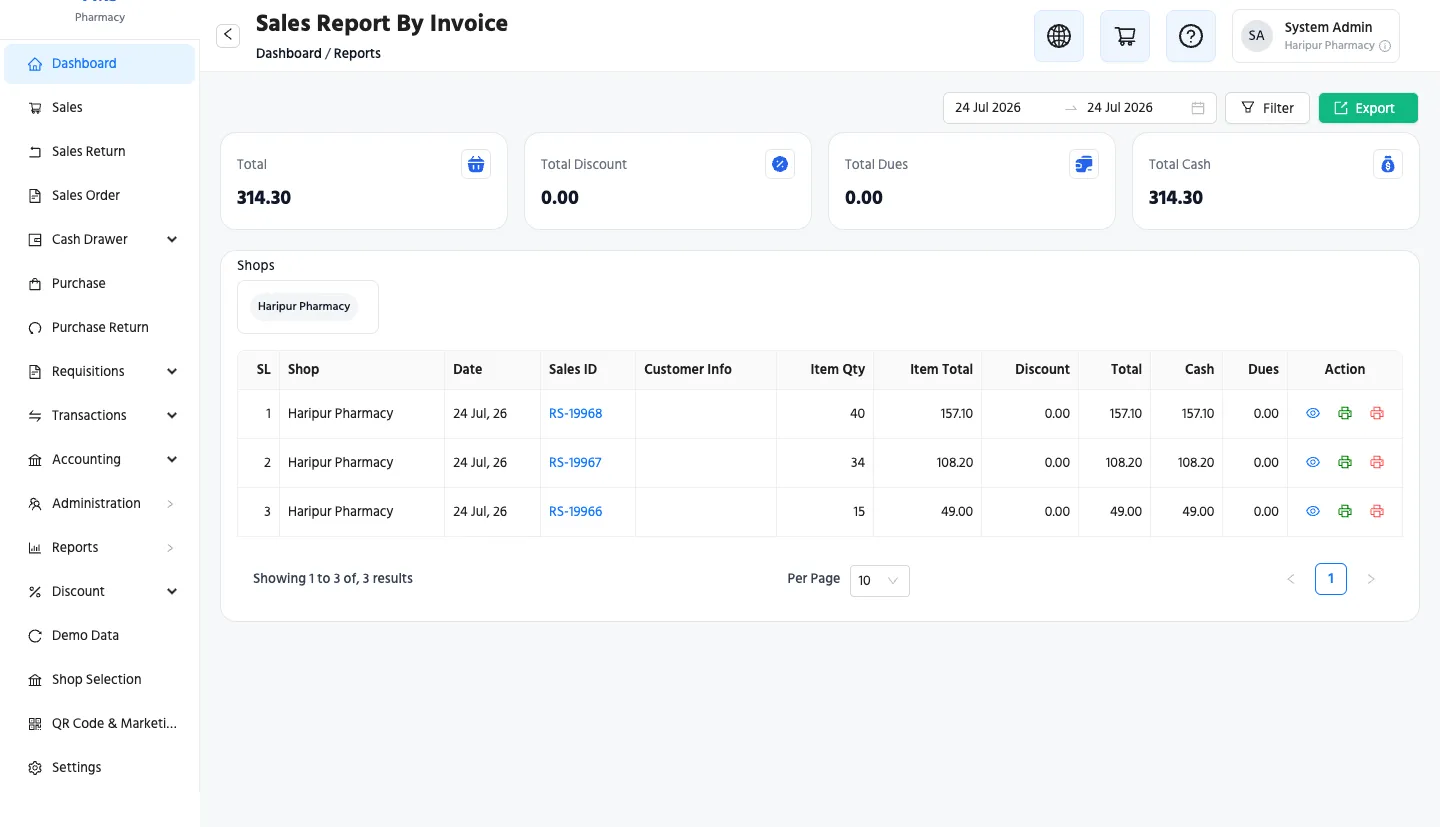 The same day, invoice by invoice — quantities, discounts, cash versus
dues, each row drillable to its items.
The same day, invoice by invoice — quantities, discounts, cash versus
dues, each row drillable to its items.
What to look for: the dues column (is credit creeping up as a share of sales?), the discount column (who is giving how much, and on what?), and the average basket (many small invoices and few large ones ask for different shelf and stock decisions).
3. Customer balances — your money in other pockets
The receivable report: what the neighborhood owes you, in total and per name. Five minutes here, weekly, is the whole collection system — pick the two or three balances that grew, and mention them gently this week. (The full discipline is in Customer baki without losing money.)
What to look for: the total trending up faster than sales — that means you’re financing your customers more each week — and any single balance quietly crossing your comfort line.
4. Supplier balances — your promises, aging
The payable report: every company, every invoice, every due. A weekly glance keeps two things from ever happening: the forgotten memo that costs you a credit hold, and the blurry total that costs you an argument. (Full post: The supplier khata.)
What to look for: dues older than your usual terms — those are the calls to make this week, before the rep makes them for you.
5. Expiry summary — losses you can still prevent
Last, the report about money that hasn’t been lost yet: what expires this month, next month, the month after — counted in taka. Every item handled while it still has supplier-return value is a loss converted into a credit note. (Full post: Expiry is a silent thief.)
What to look for: the nearest month’s value. If it’s rising week over week, your purchasing is outrunning your selling somewhere specific — drill in and find which company or category.
The habit is the feature
Any one of these reports is unremarkable. The round is what changes the shop: the same five screens, the same order, every week, ten minutes. Questions come pre-answered (“why is cash tight?” — look at dues and expiry, it’s already on the screen), problems surface while they’re small, and decisions — ordering, credit, discounts, staffing — start flowing from numbers instead of nerves.
Pick your day. Sunday evening, shutter down, tea in hand, five screens. That’s the whole system.
This closes our series for pharmacy owners: Are you actually making money? · The supplier khata · Customer baki · Where cash leaks · Expiry · Counting the drawer · Paper to software · Stock count night · Your second branch · Who can see what · Your pharmacy in your pocket · the full tour.