Stock Count Night: How to Do a Physical Count That Sticks
Every owner knows the feeling: the register says 44, the shelf says 39, and nobody remembers why. A physical count is how you make the records true again — but only if the differences you find get recorded, valued, and learned from. Here’s how to run a count that actually settles the question.
Why records drift
Even a careful shop drifts. A delivery memo said 10 boxes and contained 9. A strip broke and got tossed without a note. Two customers were served at once and one sale got entered short. None of it is scandal — it’s friction — but it compounds. After a year, the register describes a shop that no longer exists, and every number downstream (stock value, profit, reorder decisions) inherits the error.
The fix isn’t counting harder. It’s counting regularly, in small pieces, against the system — and recording every difference the moment you find it.
Don’t count the shop. Count a shelf.
The heroic all-night full count fails for a predictable reason: it’s so painful nobody repeats it, so drift gets a whole year to accumulate, which makes the next count even more painful. Break the cycle by cycling:
- One shelf or one company per evening. Twenty minutes after close, twice a week.
- Fast movers monthly, slow movers quarterly. Drift follows movement — count where the traffic is.
- Always against the system’s number. Print or open the stock list for just that shelf; you’re not discovering what you have, you’re verifying what the register claims, batch by batch.
In a few months, every shelf has been touched, and no count is ever big enough to dread.
Record the difference the moment you find it
This is the step that separates a count that sticks from a count that evaporates. When shelf and screen disagree, the difference goes into the Stock Adjustment screen right then — the counted quantity, per product, per batch:
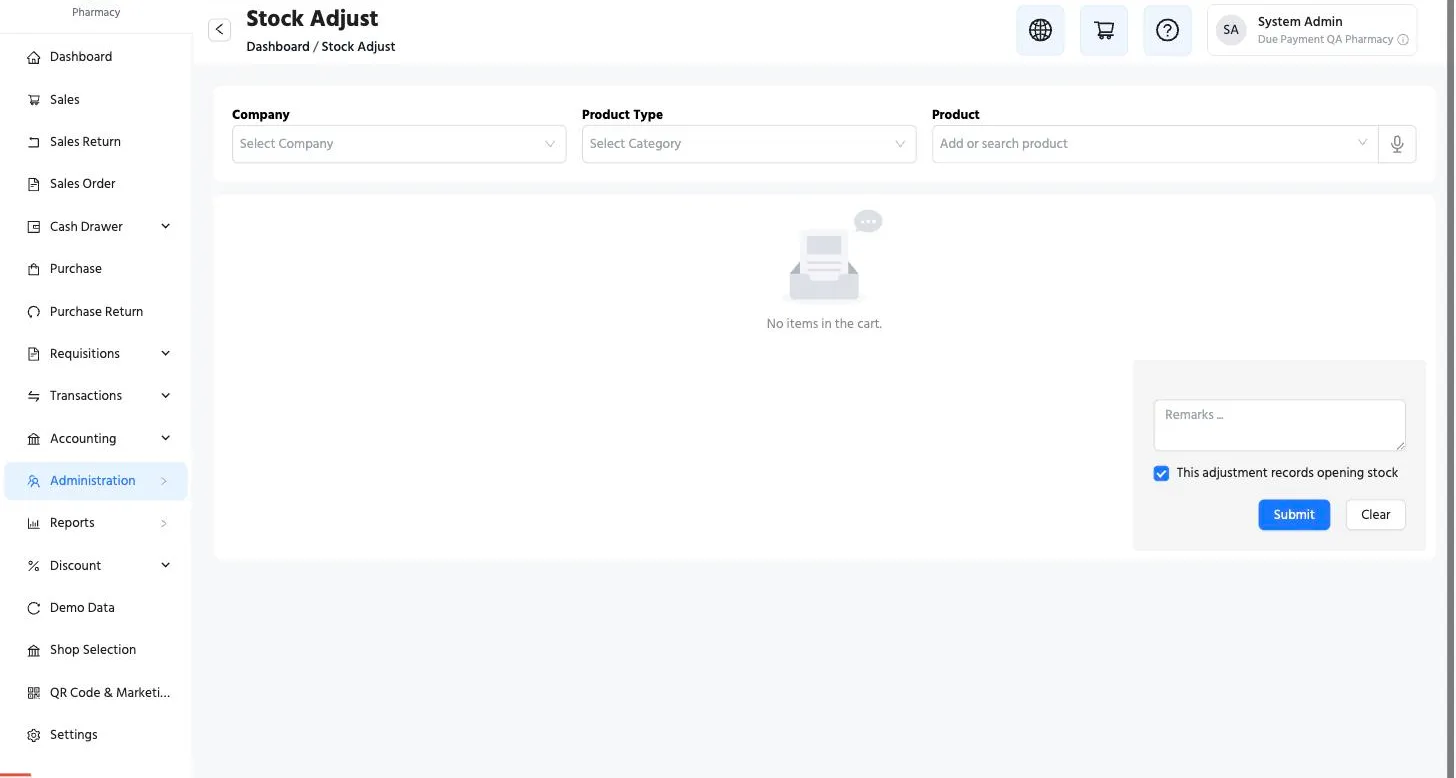 The adjustment screen reconciles counted stock against system stock,
batch by batch. (The opening-stock checkbox is for migration counts —
for a routine count of a running shop, leave it off: differences are
gains and losses, and they should say so.)
The adjustment screen reconciles counted stock against system stock,
batch by batch. (The opening-stock checkbox is for migration counts —
for a routine count of a running shop, leave it off: differences are
gains and losses, and they should say so.)
Two things happen when you submit, and both matter:
- The register becomes true. Tomorrow’s stock answer is the shelf’s answer.
- The difference gets a price. Because medipharma24 keeps real books, a shortage posts as a loss in taka and an overage as a gain — visible on your profit & loss, not swept into a corrected number that pretends nothing happened.
That second point is the discipline. Five missing strips is a shrug; “we lost ৳3,200 to stock differences this quarter” is a management problem with a number on it. Shops that value their differences find the causes — the memo-versus-carton check at delivery, the breakage note habit — because the P&L keeps score.
Read the pattern, not the incident
One count tells you the state of a shelf. Six months of recorded adjustments tell you the state of your process:
- Differences clustered on one company’s products → check that distributor’s delivery counts at the door.
- Always short on small expensive items → move them behind the counter.
- Overages as often as shortages → your entry process is sloppy in both directions; tighten the busy-hour routine.
- A sudden change in the pattern → something changed in the shop; ask what, this month, while memories are fresh.
The stock-adjustment reports hold this history for you — every count, every difference, every value, by product and by date.
The quiet payoff
A shop whose records match its shelves gets compounding rewards: reorders based on truth, a stock value on the balance sheet the bank can believe, expiry tracking that watches real batches, and staff who know that differences surface — which, gently and without accusation, changes behavior all by itself.
The register says 39. The shelf says 39. That agreement, maintained twenty minutes at a time, is worth more than any report in the system — because it’s the fact every other report is built on.
This is part of a series for pharmacy owners: Moving from paper to software · Where cash leaks in a pharmacy · Expiry is a silent thief · the full tour.