Counting the Drawer: Ending the Day Without the Doubt
Every pharmacy has a version of the same evening scene: the drawer gets counted, the number is close-ish, and someone says “more or less.” That phrase — more or less — costs more than any single shortage ever will, because it means nobody actually knows. Here’s the discipline that replaces it.
Why drawers drift
Cash drawers don’t leak through drama. They leak through Tuesday:
- Wrong change in a rush — twice, in opposite directions.
- A 500 borrowed for the delivery boy, returned tomorrow, noted nowhere.
- A sale rung as cash that was actually bKash, or the reverse.
- An expense paid from the till — tea, tape, a rickshaw — remembered as “small.”
At closing, the count is off by 180 taka. Is that theft? A mistake? Which mistake? Whose shift? With no expectation to compare against, every answer is a shrug, and the shrug repeats tomorrow. Worse: in the fog, honest staff carry vague suspicion they don’t deserve.
The discipline: open, trade, close
medipharma24’s drawer sessions wrap the day in two counts:
Open the drawer. The shift starts by counting the float — the starting cash placed in the drawer — and opening a session. Ten seconds. The system now knows the day’s starting line. The POS itself reminds you until it’s done:
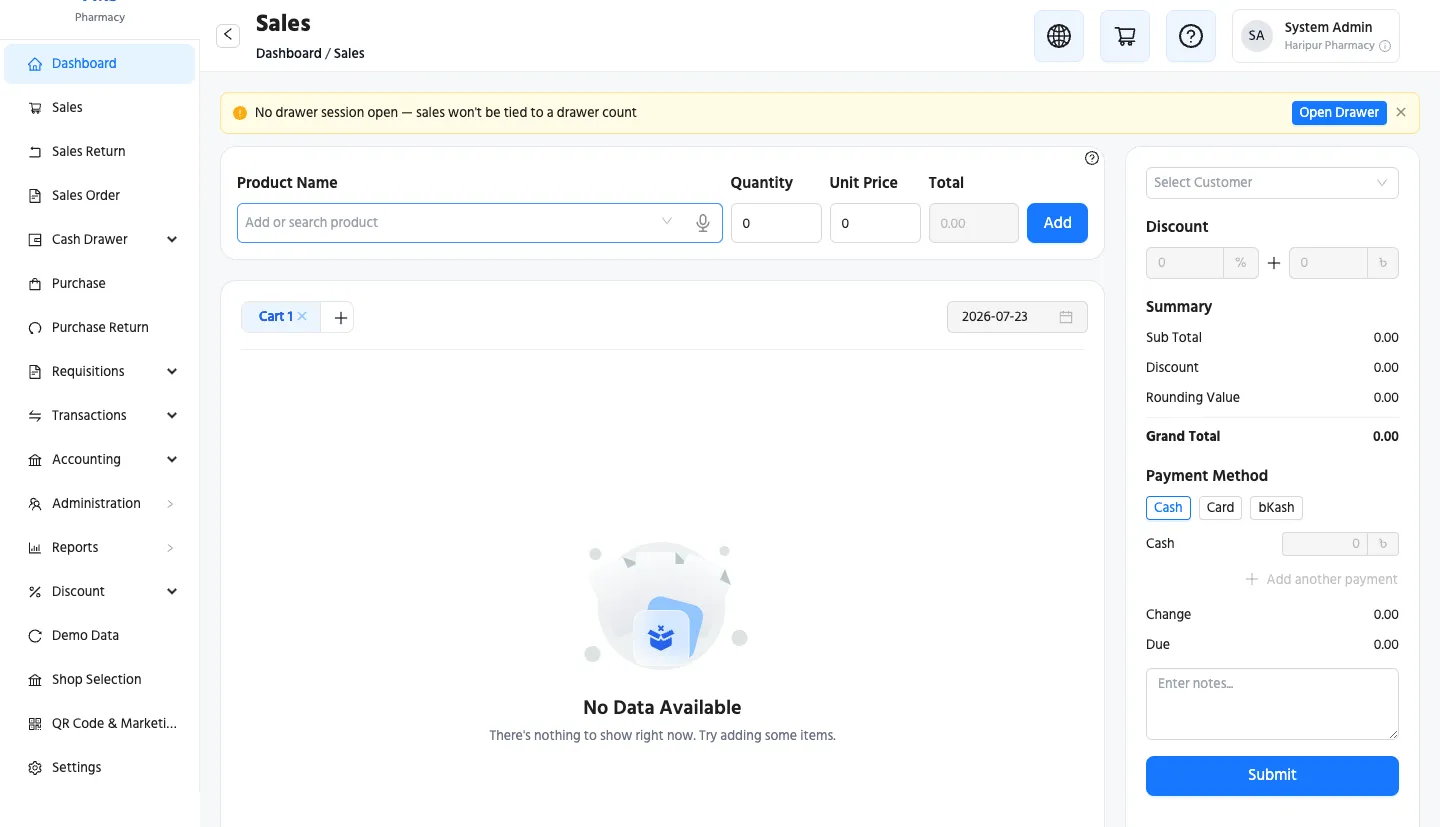 The billing screen nudges the drawer discipline: open a session, and
every cash movement that follows is attributed to it — nothing extra to
do during trade.
The billing screen nudges the drawer discipline: open a session, and
every cash movement that follows is attributed to it — nothing extra to
do during trade.
Trade normally. This is the part staff worry about, and the answer is: nothing changes. Every sale, refund, and expense already goes through the system — the session simply watches the cash ledger. No second notebook, no duplicate entry.
Close with a count. At shift’s end, count the physical drawer — by denomination (how many 500s, how many 100s…) or as a total. The system already computed what the drawer should hold:
expected = opening float + cash in − cash out
The difference between counted and expected is the variance, and it is not allowed to be vague: a non-zero variance requires a note, posts to the books as cash over/short, and freezes into the session’s permanent record. Closed sessions can’t be quietly edited later.
What the owner gets
An answer the same evening. “180 short, Tuesday evening shift, note says two customers disputed change during load-shedding.” That’s a manageable fact — hours old, attached to a shift, explained or explainable. The same 180 discovered inside a month-end blur is just corrosion.
A pattern, not incidents. The session history — expected vs counted vs variance, shift by shift, exportable — turns drawer health into a trend you can read. A drawer that’s chronically short on one shift, or short only on the busiest evenings, tells you exactly where to look and what to fix: a training gap, a process gap, or — rarely, but now provably — worse.
Books that match the till. Because variances post to the ledger, your accounting cash and your physical cash can’t silently drift apart. The balance sheet’s cash line means the drawer, not a hope. And a printable end-of-shift report — expected, counted, variance, breakdown — closes the day with a document instead of a feeling.
What staff get
This is the under-sold half. A blind count against a system-computed expectation protects the counter staff: when the drawer matches, that’s on the record too. Day after day of clean closes is a reputation, in writing. The system that catches a bad evening also documents a hundred good ones — something “more or less” never did for anyone.
Open with a count. Close with a count. The doubt has nowhere left to live.
This is part of a series for pharmacy owners: Where cash leaks in a pharmacy · Are you actually making money? · the full tour.