Your Sales Are Up. Are You Actually Making Money?
Every pharmacy owner knows their daily sales figure. Very few know their monthly profit. Those are not the same number — and the gap between them is where pharmacies quietly struggle.
Ask a pharmacy owner how business is going and you’ll hear a sales figure: “we’re doing eight to ten thousand a day.” Ask what the shop earned last month and the answer gets vague — “after everything… maybe fifteen, twenty thousand?” That “after everything” is doing a lot of work. It has to cover:
- What the medicines cost you. Not the printed trade price — what you actually paid, batch by batch, after bonuses and discounts.
- The discounts you gave. Five taka here, ten taka there, all day long.
- Expenses. Rent, electricity, salaries, the tea for the sales reps.
- What expired on the shelf. Stock you paid for and threw away.
- What walked away. Counting differences, breakage, mistakes.
Sales can go up while profit goes down — a month of heavy discounting, a fridge full of stock that expired, a salary increase — and if all you watch is the sales figure, you find out months later, usually when cash feels tight and you can’t say why.
Why the notebook can’t answer this
The math isn’t hard; the bookkeeping is. To know real profit you need the actual cost of every item sold — not this month’s purchase price, but the price of the specific batch that left the shelf. You need every discount recorded, every expense categorized, every expiry write-off valued. Done by hand, that’s a second job. So nobody does it by hand, and the question stays unanswered.
What it looks like when the system does the bookkeeping
medipharma24 keeps a full set of books underneath the screens you already use. Every sale records not just the price but the cost of the exact stock that was sold. Every discount, every expense, every supplier payment, every expiry write-off posts to the right place automatically. You never fill in a ledger — you just run the shop.
Then, when you ask “did we make money?”, the answer is one screen:
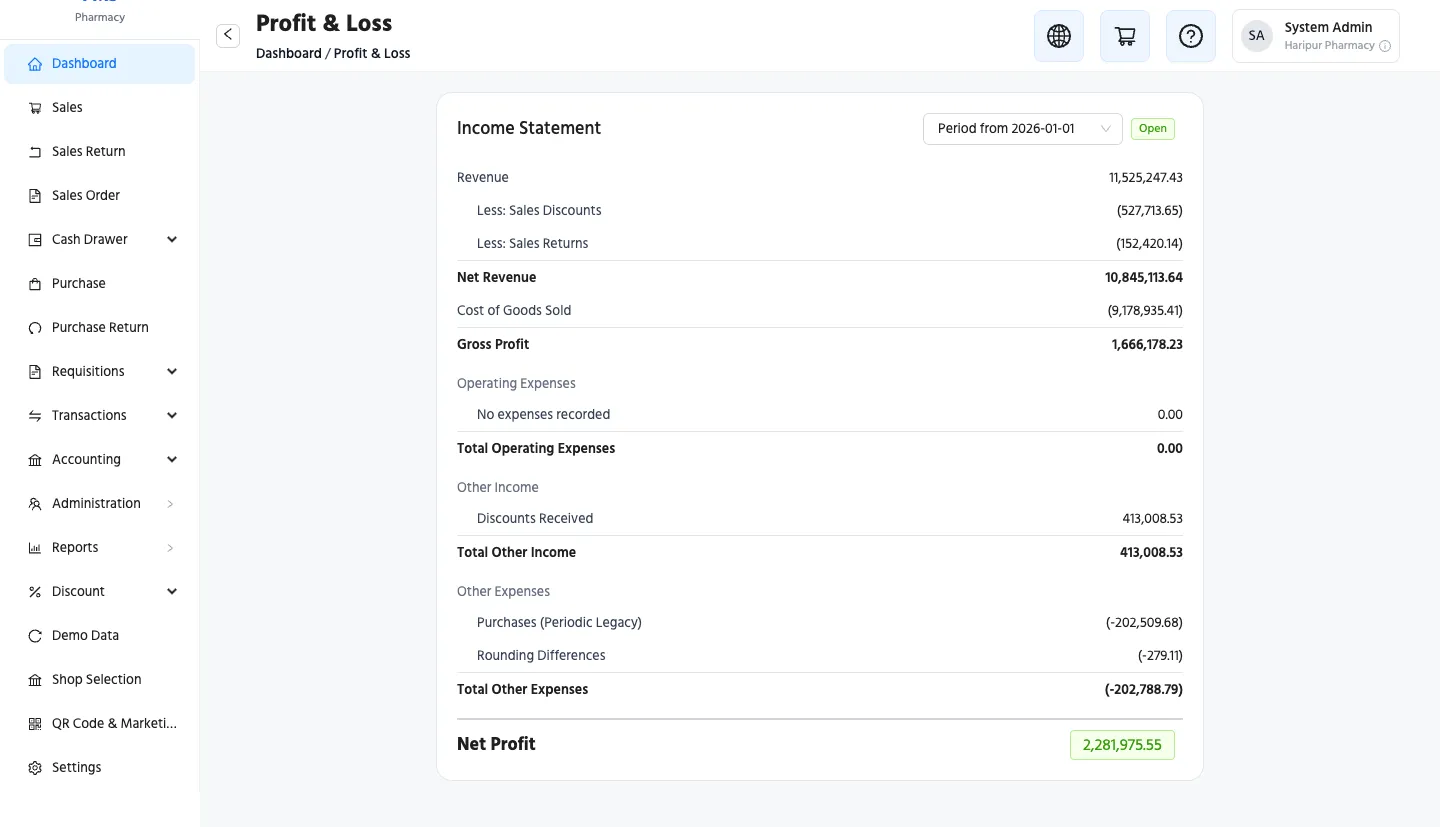 A real income statement: revenue, minus discounts, minus what the sold
medicines actually cost, minus expenses — down to the bottom line.
A real income statement: revenue, minus discounts, minus what the sold
medicines actually cost, minus expenses — down to the bottom line.
Read it from top to bottom and you’re reading your month: what you sold, what you gave away in discounts, what the goods cost, what running the shop cost, and what’s left. The bottom line is green or it is red, and either way it is true — computed from every transaction, not estimated over tea.
The three habits this makes possible
1. Judge months by profit, not sales. A 3-lakh month at thin margins can earn less than a 2.5-lakh month at healthy ones. Once you see both numbers side by side, your instincts recalibrate fast.
2. See what discounts actually cost. The P&L shows discounts as their own line. Owners are routinely surprised — the daily five-and-ten-taka goodwill adds up to a number with real weight.
3. Catch the slide early. Profit shrinking while sales hold steady means margins are leaking — supplier price creep, heavier discounting, growing expiry losses. On a P&L you see it the month it starts, not the year it hurts.
And when the bank asks
The same books produce a balance sheet — what the business owns (stock, cash, customer dues) against what it owes (supplier dues). For a loan application, a partnership conversation, or simply knowing what your shop is worth, the statement is ready before the question finishes.
This is part of a series for pharmacy owners. Start with the full tour of medipharma24, or try every screen yourself in the demo.