Customer Baki: How to Give Credit Without Losing Money
You can’t run a neighborhood pharmacy without giving baki. The uncle whose prescription can’t wait for payday, the family that has bought from you for ten years — credit is part of the trust you sell. The question isn’t whether to give it. It’s whether you know how much you’ve given.
Here’s an uncomfortable exercise: without looking anything up, write down how much your customers owe you, in total, right now. Most owners can name their two or three biggest baki customers. Almost nobody knows the total — and the total is the number that matters, because it’s your money, sitting in other people’s pockets, interest-free, undated.
The problem isn’t generosity. It’s memory:
- The 60-taka balance from a busy Friday evening that never got written anywhere.
- The slip that says “Karim bhai — 340” with no date and no detail, so when Karim bhai remembers paying 200 of it, there’s nothing to check.
- The regular customer whose baki grew 50 taka at a time until it’s suddenly four thousand, and now asking feels awkward.
Every one of these is small. Together, across a year, they’re often a month’s profit — given away by accident.
Baki as part of the sale, not a note after it
In medipharma24, credit isn’t a separate notebook — it’s the last field of the sale itself. At checkout, whatever the customer doesn’t pay is recorded as a due against their name, on that invoice, at that moment. No slip, no memory, no end-of-day reconstruction.
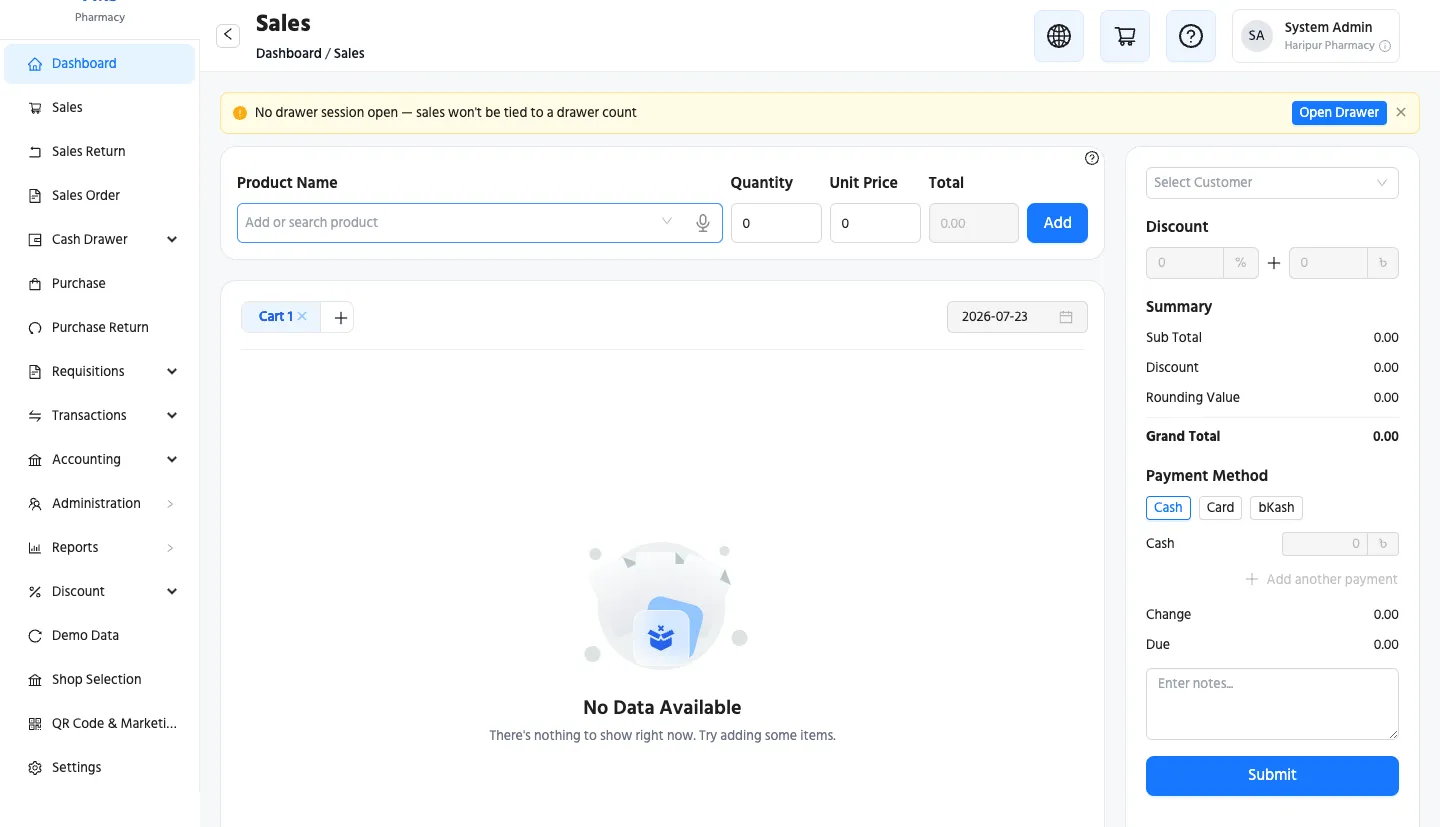 Cash, card, mobile payment, and dues are all part of the same checkout —
a partial payment takes one field, not a separate notebook.
Cash, card, mobile payment, and dues are all part of the same checkout —
a partial payment takes one field, not a separate notebook.
When the customer pays something later — all of it, half of it, 100 taka of it — that payment is recorded against their balance too. Their history becomes a statement: what they took, when, what they paid, what remains. “I think I paid that already” stops being an argument and becomes a lookup.
The number nobody knows, on one screen
The customer balance report shows the whole picture: total sale dues, total received, and the receivable balance — with every customer’s individual balance below it.
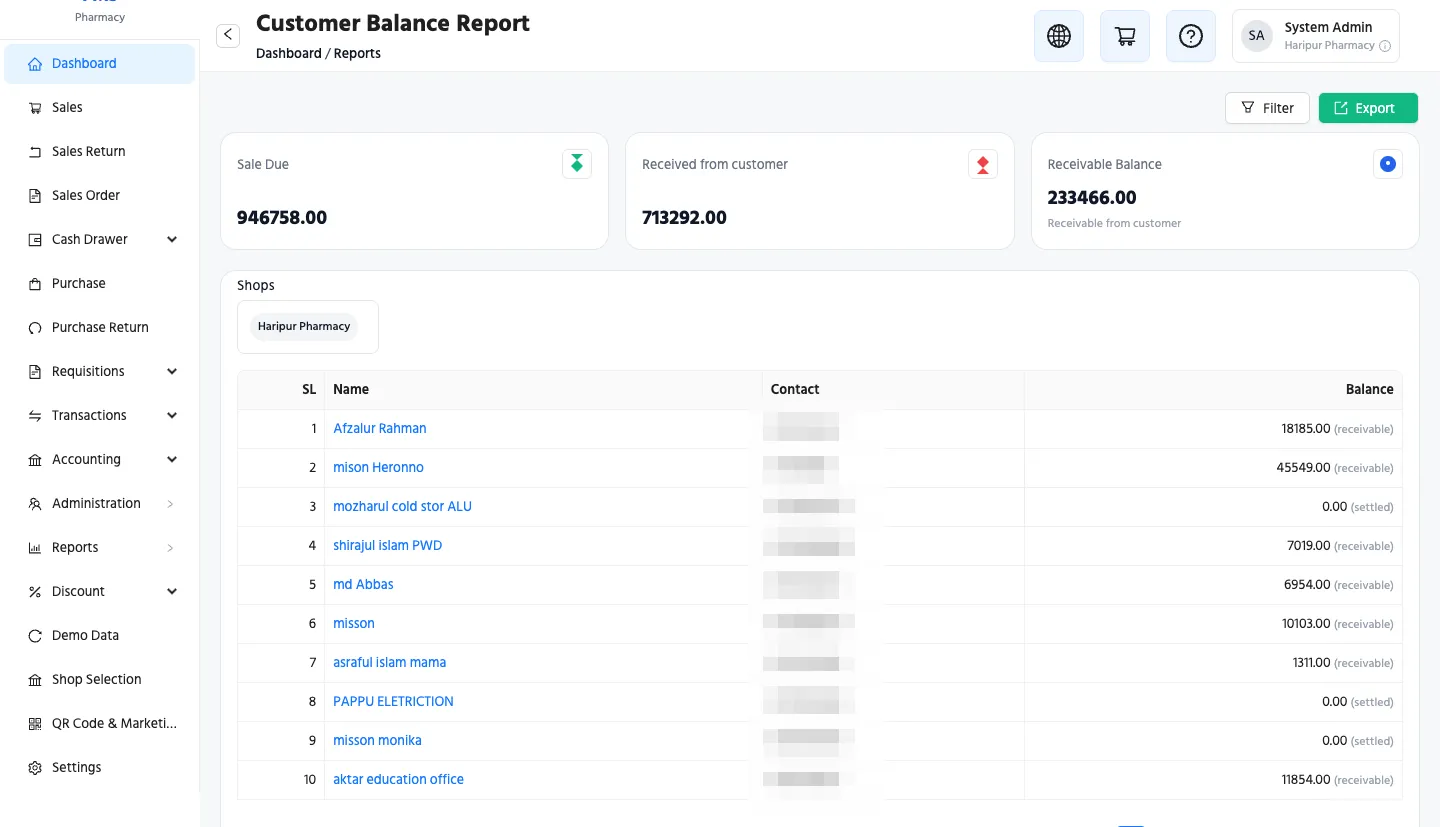 The other side of the khata: what the neighborhood owes the shop —
in total and per customer.
The other side of the khata: what the neighborhood owes the shop —
in total and per customer.
What changes when you can see this:
- Credit gets limits. When you can see a balance at the moment of sale, “another 500 on baki” becomes a decision instead of a reflex.
- Collection gets systematic. A sorted list of balances is a collection plan. Statements replace awkward guesswork — most customers pay promptly when shown a clear history; vagueness is what makes people slow.
- The business knows its worth. Receivables are an asset. They belong on your balance sheet next to stock and cash — and in medipharma24 they land there automatically, because the due was part of the sale from the beginning.
Trust, with a record
None of this makes the shop colder. You’ll still give baki to the uncle at 9pm — that’s the job, and it’s why the neighborhood comes to you and not the chain store. The difference is that the generosity is recorded: trust backed by a statement instead of memory. Your customers get the same flexibility they’ve always had. You get your money back.
Previously in this series: The supplier khata, without the khata · Are you actually making money? · the full tour.